
Illumio Alternatives: Which Microsegmentation Platform Works Best for Your Team?
You’re evaluating Illumio for microsegmentation. It’s a solid platform—but it’s built for large security teams with dedicated microsegmentation engineers. If you’re running zero-trust on a lean IT staff, you’re probably asking: is there a platform that handles this without becoming a full-time security engineering job? This comparison covers the microsegmentation platforms that compete with Illumio, what each does well, and critically—which ones are designed for teams like yours (managing security operations without specialist headcount).
Enclave microsegmentation
Try It on Your Own Environment
One enclave, three nodes, no card required. See if Enclave handles your segmentation use case before you talk to anyone.
Try Enclave Free Talk to the team first →Enclave: The Illumio Alternative Built for Generalist IT Teams
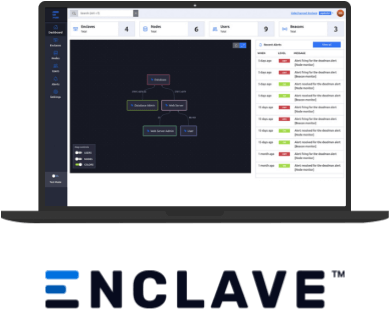
Enclave consolidates your zero-trust microsegmentation into a single control plane. Unlike Illumio’s distributed architecture, Enclave handles policy, monitoring, and enforcement from one dashboard—built for IT teams, not security engineering teams.
Why Enclave stands out:
- One-team operation. Enclave assumes your team wears multiple hats. Policies are written in plain language, deployments happen in minutes, not weeks.
- Free tier to production. Start with 1 enclave and 3 nodes/users at no cost. Scale to production-grade microsegmentation without per-appliance licensing overhead.
- CIS Controls v8 alignment. Enclave natively maps to CIS Control 2.2 (Asset Inventory), CIS Control 3.7 (Secure Access), and CIS Control 4.7 (Managed Access). Post-DBIR, this matters—your board and auditors expect CIS coverage.
- Zero-downtime Illumio migration. Already running Illumio? Enclave ingests your policy logs and existing configurations, letting you test Enclave alongside your production environment before cutover.
Best for: IT teams under 50 people, organizations consolidating ZTA without dedicated security staff, teams wanting operational simplicity over maximum configuration flexibility.
Cisco Secure Segmentation
Cisco’s segmentation play focuses on network-centric microsegmentation—enforcing segments at the network layer with policy tied to device posture and identity.
Strengths: Deep integration with Cisco ecosystem (ISE, SD-WAN, threat intelligence feeds). Strong if you’re all-in on Cisco infrastructure.
Tradeoffs: Requires Cisco network infrastructure knowledge. Not ideal if your team manages security ops separately from network ops. Licensing is consumption-based, which scales unpredictably on large deployments.
VMware Microsegmentation
VMware bundles microsegmentation through NSX Advanced Load Balancer and NSX Microsegmentation. It’s strong in virtualized environments where you can leverage existing vSphere and NSX investments.
Strengths: Deep visibility into VM workload behavior. Good if you’re hypervisor-heavy (vSphere, ESXi).
Tradeoffs: Requires VMware infrastructure expertise. Less ideal for hybrid cloud or multi-hypervisor environments. Operational overhead increases with infrastructure complexity.
Juniper Connected Security
Juniper’s approach ties microsegmentation to its broader secure access and threat detection platform. It’s positioning toward “convergence”—combining network, identity, and threat data into segmentation policy.
Strengths: Strong threat intelligence integrations. Good for organizations with advanced SOC operations.
Tradeoffs: Requires security team expertise to operationalize. Expensive for small-team deployments. Better suited to enterprises with dedicated security ops staff.
Zscaler for Microsegmentation
Zscaler positions microsegmentation as part of its cloud-native zero-trust platform, with policy tied to user identity and cloud workload attributes.
Strengths: Cloud-native by design. Works well in distributed workforce models. Integrates cleanly with Zscaler’s broader ZTA platform.
Tradeoffs: Requires cloud-forward architecture. Licensing is per-user, not per-device, which can be expensive in device-heavy environments (IoT, OT). Assumes identity-driven segmentation (may not work well for device-only or IoT networks).
Migrating from Illumio?
If Illumio is already in production, here’s the practical question: can you switch without downtime?
Enclave’s approach: ingest your Illumio policy logs and exported configurations, deploy Enclave as a parallel enforcement layer for 30–60 days, then cutover without disruption. This eliminates the “rip and replace” risk that locks you into Illumio.
Illumio migration
Switch Without the Downtime
Already running Illumio? We can walk you through what a parallel deployment looks like for your environment, then cut over when you are ready.
Book a Migration Walkthrough Try Enclave free →Conclusion
Microsegmentation is no longer optional—post-breach, it’s table stakes for zero-trust. The question isn’t whether to implement it, but how to implement it without burning out your team.
If you have a dedicated microsegmentation engineer and unlimited budget, Illumio is enterprise-grade. But if you’re consolidating ZTA on a lean staff, Enclave trades some configurability for operational simplicity—the microsegmentation work becomes ops work, not engineering work.
Try Enclave free. One enclave, three nodes/users, no card required. See if it handles your segmentation strategy.
Get Precise Control Over Who and What Reaches Your Assets
Enclave creates isolated, policy-aligned segments across your network, with real-time visibility and support for major compliance standards. Fully managed, and built to operate without adding headcount.
Book an Enclave Demo